Twenty two days ago was the last day of my University. I came home and decided to play a little game of memory. So I started looking across my bookmark list.
Links, mostly which I once visited and maybe after reading the first paragraph, decided it would be a crime to read it then, perhaps later when I could give it the right attention, when the weather is warm, and at least in some background music. Not that day, not then.
The rule of the game was to think of exactly when I saved the particular link, how many years ago. During what time of the University.
The list was very long and I went further up and found links I saved before even joining the University, links from 5-6 years ago.
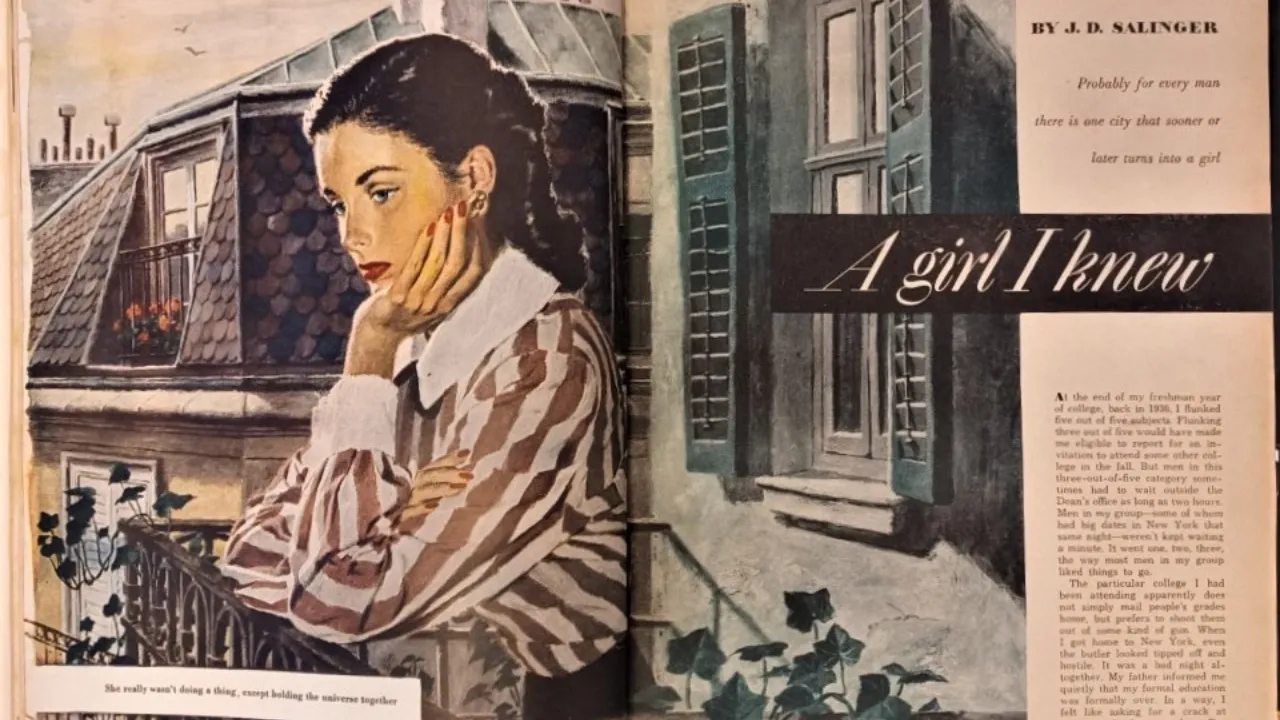
A Girl I Knew is a short story written by J.D. Salinger that appeared in Good Housekeeping Magazine in 1948. I read the story because one day I was just randomly searching for the most beautiful lines and paragraphs in literature and came across one such reddit thread.
You may know that quote already.
She wasn’t doing a thing I could see, except standing there, leaning on a balcony railing, holding the Universe together.
I read the story and thought it was good, and it was good that I was reading something, because I wanted to be a writer and I had a low attention span and a brain that demanded quick stimulation with low effort. Stories needed to be quick and to the point, movies needed to be fast and full of action. The filter which disallowed works such as of Dostoyevsky and Ozu, and only allowed content similar to Marvel movies.
I bookmarked the link. I put that quote as my favorite quote on my Facebook profile. I didn't click it again until seven days ago.
It was the first time I read such an eloquent description of someone with so little words. For me, falling in love with Leah was one of the easiest things, as far as movie and book characters are considered. How could you not when she sits, she sat down, she did the only sensible thing with her beautiful hands there was to be done: she placed them on her lap and left them there.
Her polite "sank you" instead of "thank you", her being a sincere daughter to her fazzer instead of father, her singing a song and saying "don't leave wissout me" instead of "without me". Her innocence was too much for the room and the only way to overcome it was to either talk of it or to open the windows.
But the story isn't really about any romance because there isn't. The narrator himself says:
"We just never said anything to each other. Over a period of four months, we have talked for thirty or thirty-five evenings without saying a word," and he even goes far to write that "...if I should go to hell, I'll be given a little inside room...in which all my conversations with Leah will be played back to me, over an amplification system confiscated from Yankee Stadium"
Leah was, totally, just a girl he knew, in the truest meaning of the word "knew". Because maybe, like he writes,
"I consistently hesitated to risk letting the thing we had together deteriorate into a romance. I don't know any more. I used to know, but I lost the knowledge a long time ago. A man can't go along indefinitely carrying around in his pocket a key that doesn't fit anything."
I don't have a girl I knew, like the narrator John. I don't have a city that has turned into a girl. But this story is special to me because I read it when I was just starting out, the time when I had no knowledge of how the future was going to be. And now after being in that future and re-reading it, it has become a totally new story and a relevant one.
Leah was the first person of such beauty and innocence that struck the narrator. And he only knew her, he couldn't embrace her, touch her, spend time with her in a sense that mattered enough. With the metaphor of Leah, I reflect on my childhood and the past time. When everything was simple and pulsing with innocence and beauty. When the sky was much lower, when dreams were alive and seemed achievable, contrary to now, when the world view has crumbled and everything has turned into just a naive and a fading memory.
After John went to Paris, he didn't write back to Leah, although he had assured her. He forgot her. But when the war started in Europe, John started thinking about her. And when he used to see the photos in the newspaper, he used to fiddle here and there, thinking about her. He wasn't the type of person who just sits and does nothing.
He didn't have Leah's address and her married name. He tried to gather the information but there was no link. But eventually, he returned back to Venice, as he had gotten a job in army intelligence. There he went to the same old house, same apartment where he once used to live. He goes again to the window and looks down for a moment at the balcony. Where Leah, now dead, had once stood and held the Universe together.
Leah and her family were burned in an incinerator. She had turned into just a question as such, "Yeah? What was she, a Jew or something?"
A question phrased in such indifference for many. But for John, she was someone important, not important in a way he can show to the world, but important enough by how much gravity the word "knew" can possess.
I too now reflect on my days in the University, my days in school and college. Places where I grew up. The continuous education that started when I was 4 years old has officially ended. And with it ended the only link to my childhood, except the fact that I am the same person. I am growing old and distant. Time is passing swiftly, blurring each memory. Like John at the end, I am also standing where I used to, and looking at places where once something I knew stood, something which once was very alive and innocent, something which was holding the Universe together.